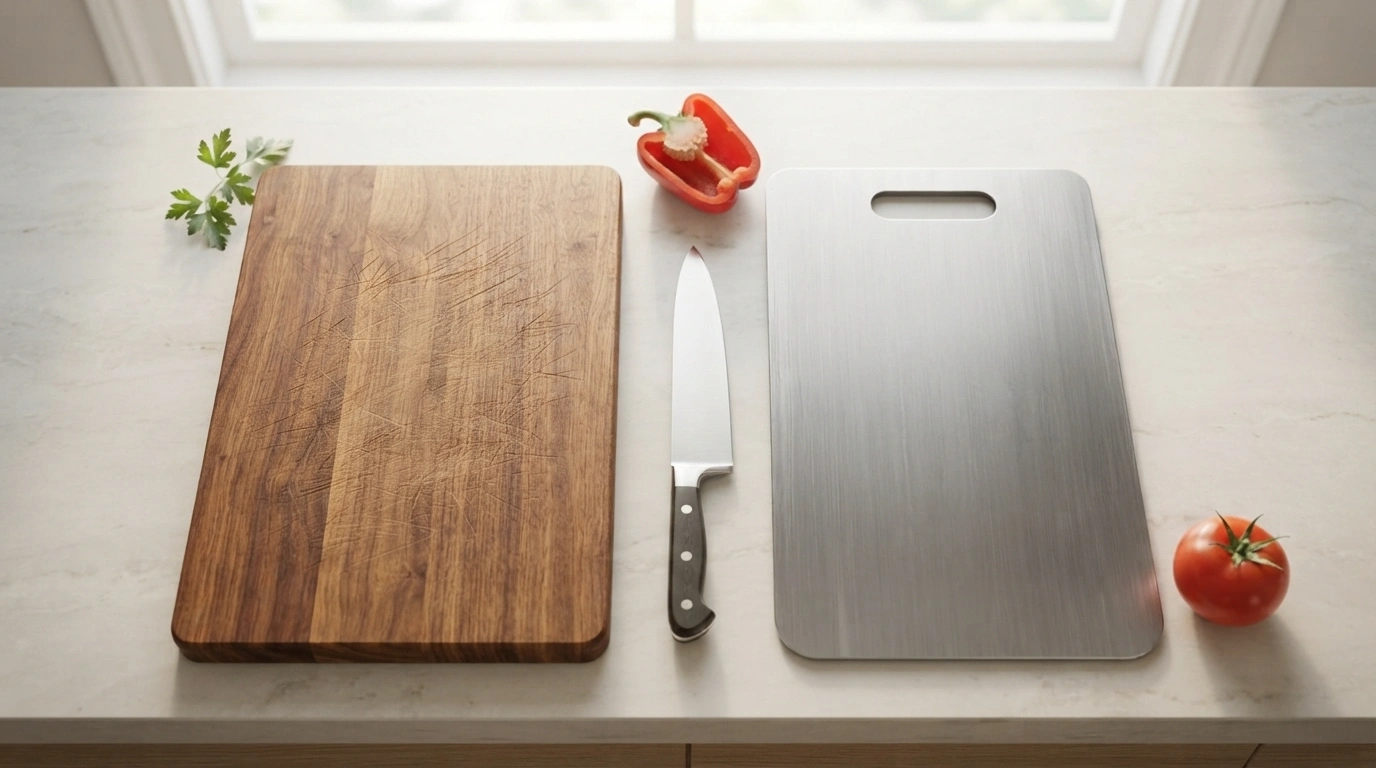
Titanium wins on hygiene, maintenance, and durability — it’s non-porous, needs no oiling, and won’t crack or warp. Wood wins on knife feel, a lower price, and a more traditional cutting experience. Neither is a wrong choice; it depends on whether hygiene and low upkeep matter more to you than feel and price.
Wood is the material most people grew up cutting on, and it has genuine advantages that titanium doesn’t fully replace. But it also has a well-documented hygiene problem that most people don’t think about until they look closely at their own board. Here’s a direct, unbiased comparison across the categories that actually matter.
What’s the Core Difference Between Them?
Wood is porous; titanium is not. That single difference explains almost every other trade-off on this list.
Wood is made of fibers with microscopic gaps between them. Every knife cut opens tiny channels in those fibers, and liquid — including raw meat juice — can seep in before you’ve even finished wiping the board down. Titanium is a solid, non-porous metal. A knife cut leaves a mark on the surface, but there’s no fiber structure for liquid to soak into. That’s the whole story behind why the two materials behave so differently in every category below.
Which Is More Hygienic?
This is titanium’s clearest advantage — and it’s backed by how food-safety inspectors actually evaluate cutting surfaces.
Deep knife grooves in a wood board are exactly where bacteria survive a normal wash; studies on cutting board hygiene consistently flag knife-scarred wood and plastic as harder to fully sanitize than smooth, non-porous surfaces. Titanium doesn’t develop the same trapping grooves in the first place, and what marks do appear don’t hold liquid the way wood fibers do. This doesn’t mean wood is unsafe with reasonable care — millions of kitchens use it daily without issue — but it does mean titanium requires less vigilance to stay hygienic.
Which Is Easier to Maintain?
Titanium, by a wide margin. Wood needs regular oiling and hand-washing; titanium needs neither.
A wood board that isn’t oiled every few weeks will eventually dry out, crack, and warp — that’s not a defect, it’s just how wood behaves. It also generally shouldn’t go in a dishwasher, since the heat and moisture cycle accelerates cracking. Titanium skips all of this: rinse it, dry it, and it’s ready for next time, with no conditioning routine required.
Which Is Kinder to Your Knives?
This is closer than most people expect. Wood has always had a reputation as the knife-friendliest material, and that reputation is earned — it’s genuinely soft on an edge. Titanium, if properly finished, is engineered to sit at a similar hardness range so it doesn’t dull blades either. The honest answer is that both are knife-friendly when the product is made well; the risk with titanium is specifically in cheaper, poorly finished boards that skip that engineering step.
Choose Titanium If…
- You want the lowest-maintenance option
- Hygiene and cross-contamination are top priorities
- You want a board that won’t crack or warp over time
- You’re fine paying more upfront
Choose Wood If…
- You prefer the classic feel and sound of cutting on wood
- You’re working with a tighter budget
- You’re willing to oil and hand-wash it regularly
- You want a board that also looks good as a serving board
| Wood | Titanium | |
|---|---|---|
| Non-porous | ✗ | ✓ |
| Knife-friendly (well-made) | ✓ | ✓ |
| Needs oiling | ✓ (required) | ✗ |
| Dishwasher-safe | ✗ | Usually |
| Typical lifespan | 1–3 yrs | Years+ |
| Starting price | Lower | Higher |
The Verdict
If you cook often and want to spend less time worrying about maintenance and hygiene, titanium is the more practical long-term choice. If you love the ritual of oiling a board and prefer the feel of wood under a knife, that preference is completely reasonable — just go in knowing the maintenance commitment that comes with it. For a deeper look at how titanium stacks up against the other common material, see our titanium vs. plastic comparison.
Considering Titanium?
We currently point readers to the Katori Titanium Cutting Board — double-sided, non-porous, knife-friendly construction.
Check Current Price →Frequently Asked Questions
Is titanium or wood better for a cutting board?
Titanium is better for hygiene and low maintenance, since it’s non-porous and needs no oiling. Wood is better for knife feel and has a lower entry price. Neither is objectively “better” — it depends on whether you prioritize hygiene and convenience or feel and tradition.
Why do chefs still use wood cutting boards if titanium is more hygienic?
Many professional kitchens use wood for feel and tradition, but pair it with strict cleaning protocols and board rotation to manage the hygiene trade-off — a home cook without that system benefits more from a naturally non-porous surface.
Does a wood cutting board need special care that titanium doesn’t?
Yes. Wood needs regular mineral oil conditioning to prevent cracking and shouldn’t go in the dishwasher, while titanium typically needs neither.