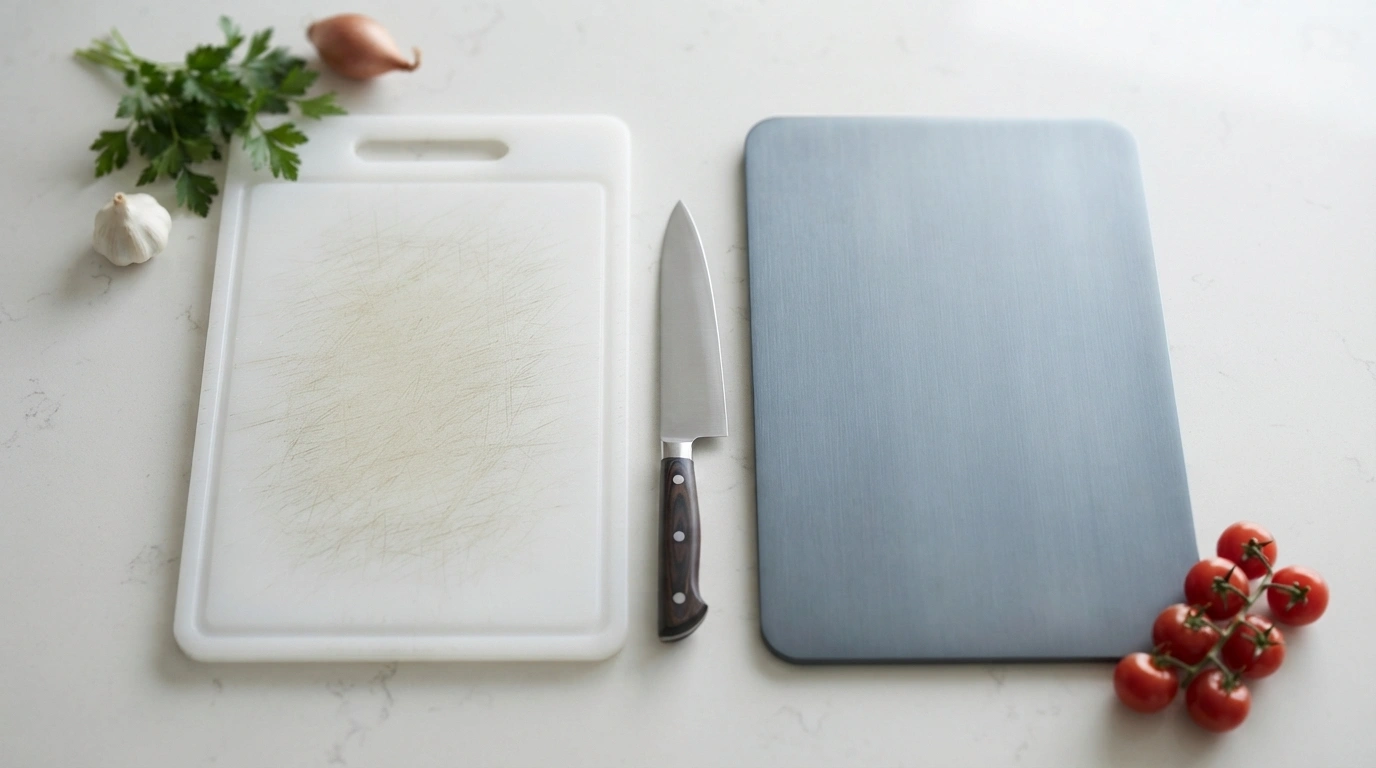
Plastic is cheaper and dishwasher-safe out of the box, but it develops bacteria-trapping knife grooves over time and has been shown to shed microplastic particles into food as it wears. Titanium costs more upfront but doesn’t groove, doesn’t shed particles, and lasts far longer — making it the better choice for anyone who cooks regularly.
Plastic is the default cutting board in most kitchens for a simple reason: it’s cheap and it goes in the dishwasher. But plastic has two problems that don’t show up until you’ve owned one for a while — knife grooves that trap bacteria, and a growing body of research on the microplastic particles it sheds into your food. Here’s how it actually compares to titanium once you look past the price tag.
The Knife-Groove Problem
Every plastic board develops grooves with use — this isn’t a defect, it’s just how a soft, knife-friendly material behaves under a blade.
Plastic’s softness is exactly what makes it kind to knife edges, but the same softness means every cut leaves a permanent mark. After a few months of regular use, those marks accumulate into a network of grooves that a sponge and dish soap can’t fully reach. Titanium’s surface is far harder to score in the same way, so it doesn’t accumulate the same bacteria-trapping terrain in the first place.
Do Plastic Boards Really Shed Microplastics?
Yes — this has been directly measured, not just theorized. Cutting on a plastic board releases small plastic particles onto whatever food is on it.
This is the newer concern that’s shifted a lot of people away from plastic in the past few years. Studies using plastic cutting boards under normal chopping motions have found measurable microplastic shedding, with older, more knife-scarred boards releasing more particles than newer ones. The long-term health effects of ingesting microplastics are still an active area of research — the science isn’t settled on exactly how much harm this causes — but for people who’d rather avoid the exposure altogether, a solid metal surface like titanium doesn’t have this issue at all, since there’s no plastic to shed.
Which Is More Durable?
A well-cared-for plastic board typically needs replacing every 1–2 years, sooner if it’s used daily or shows deep grooves and discoloration. Titanium doesn’t wear down the same way — it doesn’t groove, crack, or degrade with normal use, so a single board can realistically outlast several plastic replacements.
Choose Titanium If…
- You want to avoid microplastic exposure
- You cook often enough that a longer lifespan pays off
- You want fewer bacteria-trapping grooves over time
- You’re comfortable with a higher upfront cost
Choose Plastic If…
- You want the lowest possible upfront cost
- You cook infrequently and won’t accumulate deep grooves
- You want a lightweight, disposable option
- You’re fine replacing it every year or two
| Plastic | Titanium | |
|---|---|---|
| Non-porous | ✗ (once grooved) | ✓ |
| Sheds microplastics | ✓ | ✗ |
| Knife-friendly | ✓ | ✓ |
| Dishwasher-safe | ✓ | Usually |
| Typical lifespan | 1–2 yrs | Years+ |
| Starting price | Lower | Higher |
The Verdict
Plastic remains a reasonable choice for occasional, light cooking where cost matters more than anything else. But for anyone cooking regularly, the combination of knife grooves, replacement cost over time, and microplastic shedding tips the balance toward titanium. If avoiding plastic in the kitchen is a priority for you specifically, our guide on microplastics in cutting boards goes deeper into the research.
Considering Titanium?
We currently point readers to the Katori Titanium Cutting Board — double-sided, non-porous, knife-friendly construction.
Check Current Price →Frequently Asked Questions
Is titanium or plastic better for a cutting board?
Titanium is better for hygiene, longevity, and avoiding microplastic shedding. Plastic is better for upfront cost and is a reasonable choice for light, occasional use. For daily cooking, titanium’s durability tends to make it the better value over time.
Do plastic cutting boards shed microplastics into food?
Yes. Research has found that cutting on plastic boards releases microplastic particles onto food, with more particles shed as knife grooves deepen over time. This doesn’t happen with a solid titanium surface.
Are plastic cutting boards actually less sanitary than they seem?
Yes, once knife grooves develop. A brand-new plastic board is easy to sanitize, but the grooves that build up with regular use trap bacteria in a way a normal wash and even a dishwasher cycle don’t fully reach.