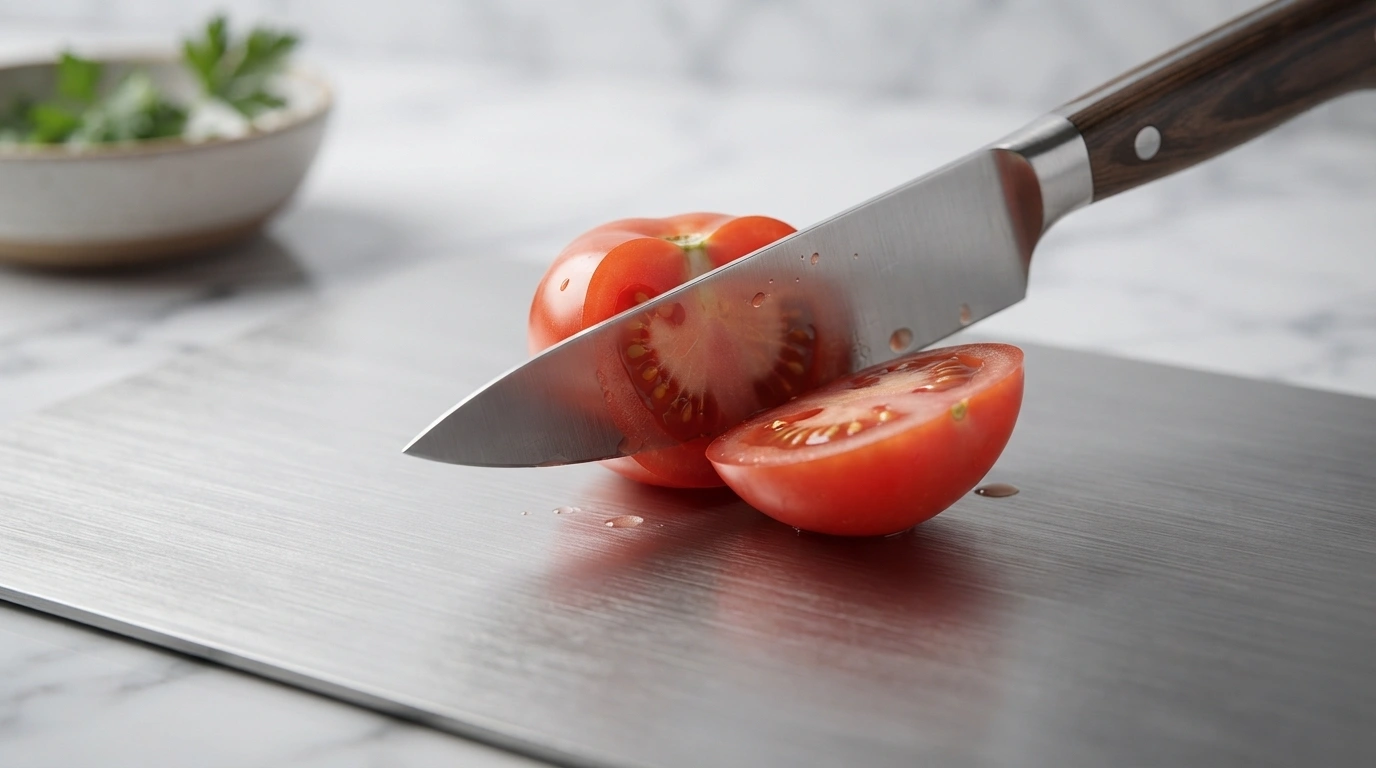
No — a properly made titanium cutting board is engineered to be softer than a steel knife blade, so it shouldn’t dull or chip your knives under normal use. The exception is poorly finished or low-quality boards that don’t get this hardness balance right, which behave more like a sharpening steel than a cutting surface.
This is the question almost everyone asks before buying a metal cutting board, and it’s a completely reasonable one — most people’s only reference point for “cutting on metal” is a butcher’s steel prep table, which absolutely will wear down a knife edge over time. Titanium cutting boards work differently, but the difference comes down to engineering, not magic, so it’s worth understanding exactly why it works and where it can go wrong.
Why Metal Isn’t Automatically Bad for Knives
Blade dulling happens when a surface is harder than the knife’s edge. Titanium boards are deliberately finished to a hardness below that of standard kitchen knife steel.
A knife edge dulls when it meets a surface hard enough to grind the metal down — think of it like a whetstone. Glass, stone, and stainless steel prep surfaces are all harder than a typical kitchen knife’s edge, which is exactly why they’re known for dulling blades quickly. Cutting board manufacturers choose specific titanium alloys and surface treatments to land below that hardness threshold on purpose, so the blade sinks slightly into the surface on contact instead of sliding across it and grinding down.
Where This Can Go Wrong
Quality varies significantly between brands — a cheap, unbranded “titanium” board with no stated hardness spec is a bigger gamble than one from a maker that specifically states it’s knife-safe.
Not every product labeled “titanium cutting board” gets the finishing process right. Some cheaper listings use a harder alloy or skip the surface treatment that makes the board gentle on blades, which can result in exactly the dulling effect people worry about. This is a real, documented complaint on some lower-quality listings — but it’s a manufacturing quality issue, not an inherent property of titanium as a material.
How Titanium Compares to Other Knife-Friendly Materials
| Wood | Plastic | Glass / Stone | Titanium (well-made) | |
|---|---|---|---|---|
| Knife-friendly | ✓ | ✓ | ✗ | ✓ |
| Consistency across brands | High | High | High | Varies |
| Risk if poor quality | Low | Low | — | Moderate |
Wood and plastic are consistently knife-friendly almost regardless of brand, because the material itself is inherently soft. Titanium can match that performance, but — unlike wood and plastic — it requires the manufacturer to get the finishing process right. That’s the trade-off: titanium adds hygiene and durability benefits wood and plastic don’t have, but it shifts more of the “will this be safe for my knives” question onto product quality rather than the material category alone.
Signs of a Knife-Safe Board
- Manufacturer explicitly states knife-friendly or blade-safe
- Reviews don’t mention dulling complaints
- Comes from an established, reviewed brand
- Clear material/grade information listed
Red Flags to Watch For
- No hardness or grade information at all
- Extremely low price with no brand reputation
- Reviews mentioning dull or chipped knives
- Marketing that doesn’t mention knife safety specifically
What To Do If You’re Still Cautious
If you want to hedge, a double-sided titanium board lets you keep one face for lighter tasks and reserve your best knives for a face you trust more, though in practice this is rarely necessary with a reputable product. Reading recent buyer feedback specifically for knife complaints — not just general reviews — is the most reliable way to check before you buy, which is exactly what we cover in our roundup of real buyer reviews.
Looking for a Knife-Safe Option?
We currently point readers to the Katori Titanium Cutting Board — engineered to be knife-friendly, non-porous, double-sided.
Check Current Price →Frequently Asked Questions
Does cutting on titanium dull knives faster than wood or plastic?
Not if the board is properly made. A well-engineered titanium board is finished to a hardness softer than a knife’s edge, so it performs similarly to wood or plastic. Poorly finished or overly hard titanium boards are the exception, and can dull blades faster.
Is titanium harder than steel knife blades?
It depends on the specific alloys involved, but cutting board manufacturers deliberately choose a titanium grade and finish that sits below typical kitchen knife hardness, precisely so the board doesn’t act like a sharpening surface.
How can I tell if a titanium cutting board will be knife-friendly before buying?
Look for products that explicitly state they’re finished to be blade-safe or knife-friendly, check reviews for knife-dulling complaints, and be cautious of very cheap, unbranded listings with no material specifications.